
Which Meditation Is Right for Me?
I believe the best chance you have of sticking to a meditation practice...
is to find the one that suits your personality. There are many types of meditation, but not all of them will resonate with you. That’s why I’ve compiled descriptions of some of the more common practices to help you find the best fit. If you’re like me, you might even enjoy using more than one meditation modality!
BREATH-CENTERED MEDITATION
Best for those who want to experiment with the breath; have unobstructed breathing; want the simplest (not necessarily easiest) form of meditation
Although most meditation practices involve the breath, this one focuses solely on it, which serves a number of purposes. The breath is our greatest tool for calming the nervous system, staying focused, and letting go. When the mind wanders during meditation, you can always return to the breath. Your breath is your best friend.
There are many ways to use the breath. The simplest breath-centered meditation is to simply be aware of your breath:
1) Sit comfortably. Don’t worry about sitting in a lotus position (although you can!) or placing your hands in any particular position. Comfort is what matters.
2) Gently close your eyes.
3) Take 3 deep breaths. Inhale through your nose and out through your nose or mouth, although the nose is preferable. You will more commonly hear teachers say to breathe out your mouth, but if you are able, I suggest breathing through your nostrils. Ayurveda teaches that we take in prana (life force energy) through our breath, so exhaling through the nose helps retain it rather than release it through the mouth.
4) Now breathe naturally.
5) Thoughts will inevitably arise. This is natural. Don’t stress over this. Your mind is just doing what it is designed to do. Simply notice them, let them go, and return your focus to the breath. Notice how the air feels cool on the inhale and slightly warmer on the exhale. You might even silently say “breath” to stay centered.
6) Each time a thought enters your mind, gently bring your attention back to your breath.
7) For a more structured practice, try counting your inhales and exhales. For example, breathe in to the count of 4, hold your breath to the count of 4, breathe out to the count of 6, hold for a count of 4, and repeat. Why the longer exhalation? Studies have shown that longer exhalations have a deeper calming effect on the nervous system. See Effects of Longer Exhalations for a more in-depth explanation.
8) Try to work up to doing this 30 minutes in the morning and 30 minutes at night, but even 10 minutes is beneficial!

GUIDED MEDITATION
Best for those who prefer direction; struggle to stay focused without guidance; want to be taken on a journey; or want to meditate on a particular issue
What I love about guided meditations is the variety. You can choose a meditation for nearly anything. Want to meditate on chronic pain, your inner child, forgiveness, releasing anger? There are meditations for almost anything you can imagine. You can choose the teacher, the music or nature sounds, or silence. You can choose the length of meditation as well. Meditation apps are plentiful, and most offer some free content. Expanded content is available with a paid subscription. They also occasionally offer a sale on subscriptions. Here are some of the best:
1) Insight Timer – This meditation app has more than 95,000 free meditations from some of the best meditation teachers across the globe, including davidji, Tara Brach, Jack Kornfield, Thich Nhat Hanh, and Sharon Salzberg. Meditations are available 24/7. Many Insight Timer teachers also offer live group sessions. Insight Timer also offers self-paced courses (10- or 30-day programs) with a paid yearly subscription ($59.99 US), which is well worth it for the depth of content.
Visit Insight Timer
2) Calm – Although a bit more limited than Insight Timer, Calm does have some interesting offerings. Their meditation tab is sub-categorized into the following:
- Sleep
- Anxiety
- Beginners
- Relationships
- Personal Growth
- Kids
- By Guest Instructors
- Relaxation
- Inner Peace
- Emotions
Calm also features “Scenes,” where you can view a beach, mountain, or lake while listening to nature sounds—perfect for meditating with your eyes open. If you prefer meditation without guidance, music or soundscapes are also available.
Some content is free, but a full subscription is required to access most features: $69.99/year or $399.99 for a lifetime membership.
Visit Calm
Headspace – This meditation app is similar to Calm in its offerings, but it’s a bit more “cutesy” with its animated content. Like Calm, it has sleep-themed meditations with topics such as:
Coping with Cravings
Acceptance
SOS Meditations for Losing Your Temper or Panicking
Headspace offers a free 11.5-minute beginners meditation as well as some basics on how to get started, such as what to wear, how to sit, how long to meditate for, and busting some common meditation myths. Subscriptions are $69.99 per year, or monthly at $12.99.
Visit Headspace
MANTRA MEDITATION / PRIMORDIAL SOUND MEDITATION
Best for those who are interested in mantras; interested in Sanskrit or Vedic chant; require more pointed focus; are ready to challenge yourself with unfamiliar language
This is the tradition I was trained in, though I vary it with other practices now. Primordial sound meditation (PSM) involves the use of a mantra to help focus the mind and quiet the thoughts. These mantras come from the Vedic tradition founded in India. The Sanskrit word mantra means “tool of the mind” (man = mind; tra = instrument/mechanism/vehicle).
Everything in the universe has a vibration. Even objects that appear to be still are not truly still. Movement is constant. If you go through PSM training or you study with a PSM teacher, you will be given your personal mantra based on vibrational sound the Earth was making at the time of your birth.
Mantras are used for their vibrational quality, not their meaning. Mantras are believed to induce quiet, calm, and peaceful states, and they are preferred to images that might conjure up thoughts.
There are many mantras you can use if you don’t have a personal mantra (or even if you do!) Here are some of commonly used mantras:
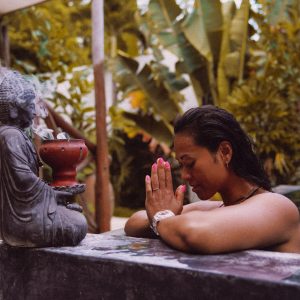
1) So hum = “I am” or “I am that”
2) Om = this is thought to be the sound that encompasses all others, or “the sound of the Universe,” “the original vibration”
3) Shanti = peace
You can also use a bija mantra. Bija is the Sanskrit word for “seed.” These mantras are a bit longer because they all begin with Om and they end with Namaha. The literal translation of the Sanskrit Namaha is “not mine,” but it is interpreted to mean an honoring or salutation. So a bija mantra starts with the universal vibration (Om), the seed word or heart of the mantra—for example, “Moksha,” or emotional freedom, and dedication (Namaha). The bija is the only part that you change based on what you want to meditate on. Here are some examples:
1) Om Suryaya Namaha = Mantra to the sun
2) Om Ritam Namaha = Mantra for truth
3) Om Hreem Namaha = Mantra to induce joy

Walking Meditation
Best for those who find it very difficult to stay still; prefer movement; enjoy being outside; feel inspired, calm, or peaceful when moving
The one thing that separates walking meditation from other forms of meditation is that you must do this with your eyes open. Meditations are typically done with the eyes closed to help quiet the mind by blocking out visual stimulation. But walking meditations definitely have a place in the meditator’s toolkit.
A walking meditation is about mindfulness, the breath, and your sense of awareness. The breath is gentle; you tune in to physical sensations; and you notice your surroundings. Notice if you’re holding tension anywhere while you’re walking. Common places to hold tension are the shoulders, facial muscles, and abdomen. Make a conscious effort to relax them. Keep your eyes ahead and slightly downcast.
If weather permits, I suggest going outside for your walking meditation. Nature heals, calms, and induces a sense of well-being. If you can walk near trees, a mountain, beach, or a body of water, such as a lake or river, even better. If not, just walk someplace quiet and unpopulated. Some people find it meditative to walk in a labyrinth.
Take three deep breaths before walking. Then walk slowly down a path, a winding road, through the forest, or wherever you’ve chosen to walk. When your mind starts to wander, pay attention to your breath. Are you taking even, gentle breaths? If you are breathing quickly or your breaths are shallow, slow your pace.
Notice your surroundings. Do you see trees, water, animals, insects, people, grass, rocks? If you are feeling grateful for what you see, you can offer up a thank you to the Universe, Source, God, or whatever you perceive to be nature’s creator.
Notice other sensations. What do you feel on your skin? What do you hear? Is there a scent in the air? Walking meditations allow for awareness of things we normally do not notice. This will help you develop a sense of mindfulness.
I often doing walking meditations in my own backyard or front yard. I just walk in large circles. I take in the desert air, the trees, the rocks, the mountains, the coyote howls, the dogs barking, the birds chirping.
If you cannot be outside, see if you can find a stretch of indoor area that is quiet, where you can walk, even if you have to keep going in circles. I sometimes do walking meditations in my home.
VIPASSANA MEDITATION
Best for experienced meditators; highly committed individuals; those comfortable with sitting for long periods; those willing to take a course or retreat
Vipassana is believed to be the oldest Buddhist tradition. It is translated to mean “insight” or to “see the true nature of reality.” This meditation is an introspective practice aimed at deep awareness of the self and our illusion of separateness from others. It is believed to lead the practitioner toward the Buddhist belief in impermanence and the attainment of egolessness.
Vipassana is a precise practice, where one focuses on micro-movements, such as the beginning, middle, and end of each breath. It asks that we make note of whatever we notice by mentally verbalizing these things. For example, if a thought arises, we gently think “thought.” Or if we feel warm, we mentally note the word “heat.” Similar to primordial sound meditation, this is a way of helping the mind acknowledge thoughts and sensations without allowing them to dominate. Vipassana is essentially a two-step process: train the mind to release distractions, and then allow for an awareness of the self to be revealed.

Vipassana suggests that you sit, with legs crossed, as the Buddha is believed to have sat, although comfort is important. Vipassana practitioners often practice one hour in the morning and one hour in the evening. Because of some of the challenges of the practice, many meditation students attend a Vipassana retreat to immerse themselves in the experience of this form. It is typically a 10-day retreat held in silence. Stringent rules are often in place, such as limited eye contact, separation of males and females, and very early rise times.
TRANSCENDENTAL MEDITATION (TM)
Best for those who want to focus more on mantra than breath; prefer a less structured practice
Transcendental meditation is very similar to mantra meditation/primordial sound meditation, but the mantras used are not chosen in the same manner as PSM. They might even be based on the teacher assigning the mantra rather than your personal information. It can vary. If you were to be instructed in transcendental meditation, the teachings would likely be very different than in PSM. TM promotes the same outcomes as other meditations, but with a focus on mantra repetition and simplicity.
Transcendental meditation says that practitioners should do the following:
1) Sit in a comfortable position.
2) Close your eyes and take a few deep breaths.
3) Start mentally repeating your mantra.
4) Gently let thoughts go as they arise.
5) Sit for 20 minutes.
6) Slowly open your eyes and come out of the meditation.
Let’s Connect! For comments, writing assignments, or product reviews, please email me at Val@ValTheWellnessGal.com